BJC Machine Tools — Connecting Warehouse and Technician Van Inventory in One System
How an Australian CNC machine sales and service business replaced spreadsheet-based stock management with a connected inventory system spanning warehouses, head office and technicians’ repair vans.
The Challenge: When Inventory Doesn't Stay in the Warehouse
BJC Machine Tools is an Australian-owned company providing CNC machine sales, service and support to businesses across Australia.
Its technicians travel to customer sites for breakdown repairs, scheduled maintenance and ongoing machine support.
That created an inventory challenge that was different from a conventional warehouse operation.
BJC's stock wasn't sitting in one place.
Parts could be held at head office or in warehouses, while other inventory travelled with technicians inside their repair vans.
Those vans effectively became mobile inventory locations.
As the business expanded, BJC was relying on Excel spreadsheets to keep track of stock across these different locations.
Multiple employees could be involved in updating the same information. Understanding current stock levels required manual administration, reporting took additional effort, and it was difficult to maintain one reliable view of what was available across the operation.
The problem wasn't simply that BJC was using spreadsheets.
The inventory had become distributed across the business, but the information needed to manage it wasn't connected.
A Service Van Is More Than a Vehicle
For BJC, a technician's repair van wasn't simply transportation between jobs.
It carried parts technicians may need while servicing or repairing CNC machinery at customer sites.
That introduced a different set of operational questions:
- What stock is available at the warehouse?
- What has been allocated to a particular van?
- What does the technician currently have available?
- What needs to be replenished?
When that information is maintained manually across spreadsheets, keeping an accurate picture becomes increasingly difficult as the number of locations, vehicles, parts and employees grows.
BJC needed a way to treat its warehouses and repair vans as part of the same inventory operation.
Building Around BJC's Real Inventory Workflow
ISH Technologies worked closely with BJC Machine Tools to understand how stock moved through the business.
The objective wasn't simply to replace Excel with another stock list.
The system needed to reflect an important reality:
Inventory could exist in different places, and one of those places could be a technician's van travelling between customer sites.
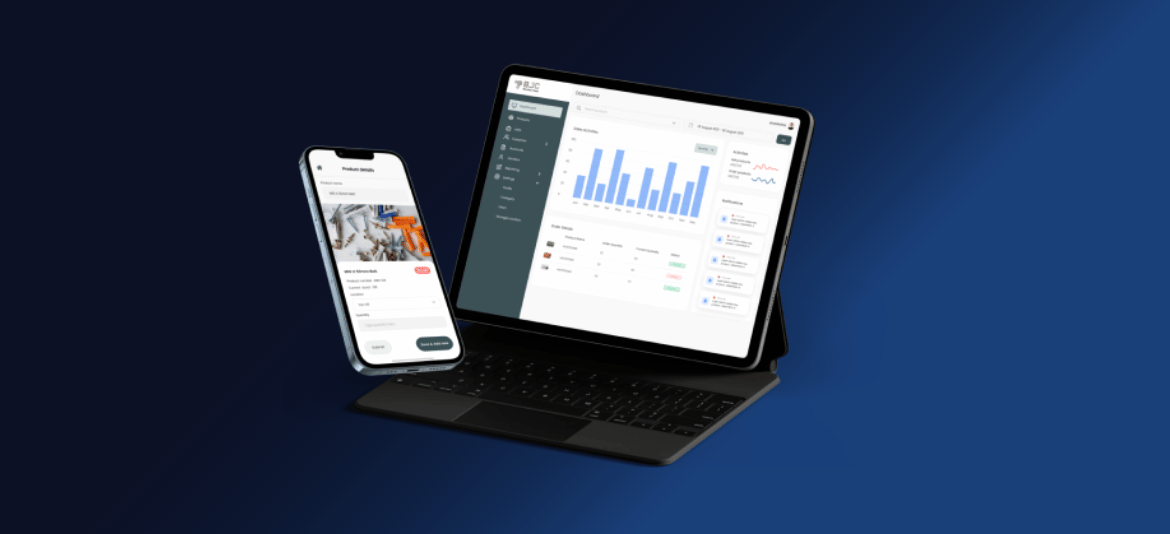
ISH developed a purpose-built inventory management system that brought stock information from head office, warehouses and repair vans into one central environment.
Instead of maintaining separate views of inventory, the business could manage these locations as part of one connected system.
Knowing What Is Where
The new platform provided visibility of inventory across BJC's different operational locations.
Stock held within warehouses could be managed alongside stock allocated to repair vans, giving the team a clearer view of where inventory was located.
This was particularly important for field service.
Knowing that a required part exists somewhere in the business isn't necessarily enough when a technician is working at a customer's site.
The useful question is whether the right part is available in the right place when it is needed.
By bringing warehouse and mobile inventory together, BJC could manage stock from a broader operational view rather than depending on manually maintained spreadsheets.
Using Barcodes to Connect Physical Stock and Digital Records
Barcode functionality was introduced to support inventory management and stocktake.
Instead of relying entirely on manual identification and spreadsheet updates, stock could be recorded through the digital inventory process.
This created a more direct connection between the physical parts being handled and the inventory information held within the system.
For a business managing stock across fixed warehouses and mobile repair vans, this provided a more structured way to perform stocktake and maintain inventory information.
Knowing What Needs to Be Replenished
Visibility alone wasn't the only requirement.
BJC also needed to know when stock at a particular location was becoming low.
The system could monitor stock levels against defined thresholds and alert managers when inventory needed attention.
This is particularly relevant when the inventory location is a repair van.
A shortage discovered while managing stock is one thing.
A missing part discovered after a technician reaches a customer site can become an operational problem.
The system gave BJC a better way to identify stock requirements across its different locations and support the replenishment process.
Turning Inventory Activity Into Useful Information
The platform also made inventory reporting more accessible.
Instead of manually compiling information from spreadsheets, BJC could generate reports using information already being maintained within the system.
This gave management a clearer view of inventory levels and movement across the operation without relying on separate spreadsheet reporting processes.
Connecting the Warehouse With the Field
The biggest change for BJC wasn't simply moving inventory from Excel into software.
It was recognising that its inventory operation extended beyond the warehouse.
Head office, warehouses and technicians' repair vans all formed part of the same stock environment.
The new system provided a way to connect those locations, maintain inventory information, support barcode-based processes, monitor stock levels and provide management visibility from one operational platform.
The warehouse may end at the warehouse door. BJC's inventory operation doesn't.

Does Your Inventory Leave the Warehouse?
For BJC Machine Tools, inventory wasn't held in one location.
Stock was spread across warehouses, head office and technicians' repair vans.
Managing those locations through Excel made a simple question increasingly difficult to answer:
What stock do we have — and where is it right now?
When multiple people are manually updating inventory across warehouses and vehicles, maintaining an accurate view of stock becomes difficult.
That can mean stock shortages, unreliable reporting and more administration just to understand what is available across the business.
BJC needed its warehouses and repair vans to operate as one connected inventory environment.
Because when your inventory moves beyond the warehouse, your visibility needs to move with it.
Contact us
1300 474 832